

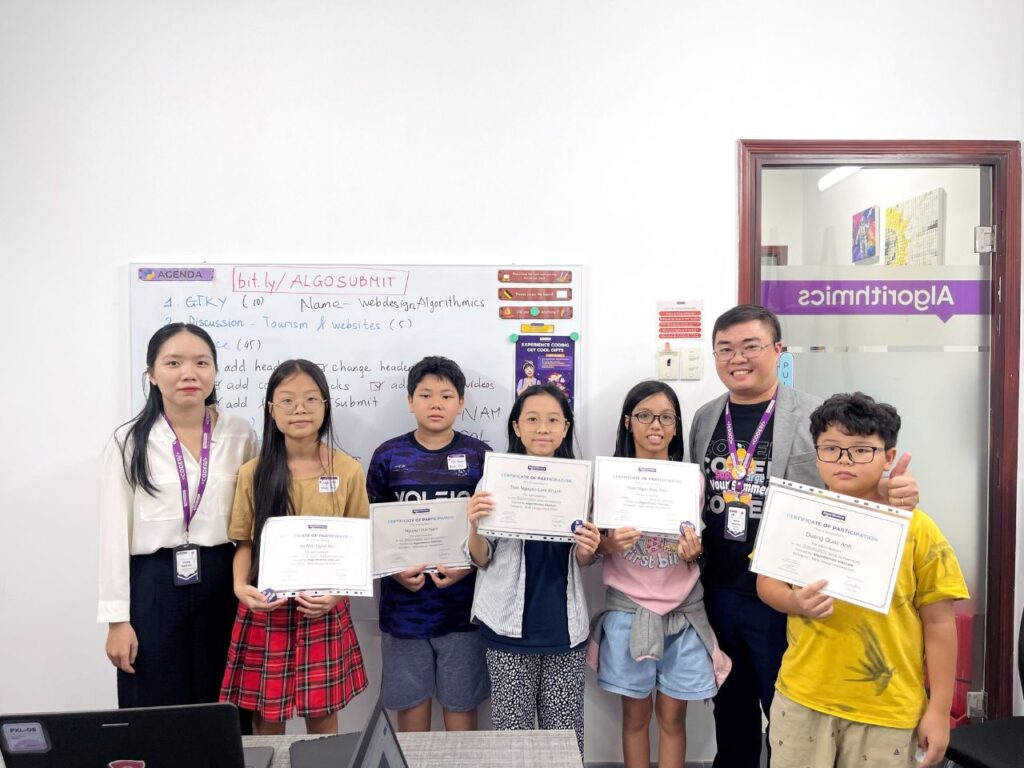
With the desire to spread the dream of coding to more children, Algorithmics organizes 2 special courses for students of VAS. Through these courses, children not only gain access to a globally standardized international education but also accumulate many important skills, creating opportunities for diverse future career paths!
Algorithmics Teaching Methodology places a strong emphasis on delivering high-quality education through a structured approach:
Qualified Teachers: Our teachers are composed of certified professionals from Algorithmics, ensuring a standard of excellence in education.
Teaching Assistants: Dedicated teaching assistants play a crucial role in providing support and fostering student engagement, creating a positive learning environment.
Learning Platform: Our platform is designed to offer a personalized learning experience, allowing students to progress at their own pace. It provides endless practice opportunities to solidify understanding, all while ensuring a fun and engaging educational experience.
Student-Centered: At the core of our approach is a commitment to student-centered learning. We believe in active participation and practice for every student, tailoring the educational journey to individual needs and preferences. This ensures that each student receives the attention and guidance necessary for their academic success.
Introduction: 5 minutes
Teacher greets students, introduces the agenda for the lesson, relates application of learned skill to real world.
Group Discussion: 10 minutes
Students discuss topic area in more detail and explore creative options. Teacher reviews discussion to share ideas.
Demonstration: 10 minutes
Teacher demonstrates how to apply learned skill and models what students are expected to do.
Practice: 30 minutes
Students practice skill through teacher modelling and staged platform progression. Moving from structured to independent practice. Teacher monitors, corrects and encourages students.
Review: 5 minutes
Students Log out and shut down computers. Teacher reviews key concepts and challenges from the lesson.
Age: 7-12
VAS students will all enter a competition to build the best website over the 10 week course. Entrants will be judged on overall design, features, functionality, layout and uniqueness. Winners and runners up will receive cool prizes.
This course allows students to look into the future of digital and AI usage for education and work. Starting with understanding the process of safe web research students then create their own website, which is used to hold a portfolio of projects through the rest of the course demonstrating their skills.
They engage design and architecture skills through software and AI. Then they practice using AI writing and video making skills. On the final day, we combine these tech skills with soft skills to present their learning achievements and announce the winners and runners up of the competition.
Lesson 1: Introduce about AI
Lesson 2: Create your first website
Lesson 3: Use Graphic Editor to create images
Lesson 4: Use AI Writer - Bing.com to create descriptions
Lesson 5: Use AI Designer - PlaygroundAI to create images with AI effects
Lesson 6: Use AI Tech - Planner5D to build a structure
Lesson 7: Create your first slides in Canva
Lesson 8: Create your first video in Canva
Lesson 9: Finalize and practice for presentation
Lesson 10: Graduation and prize giving
Age 8-13
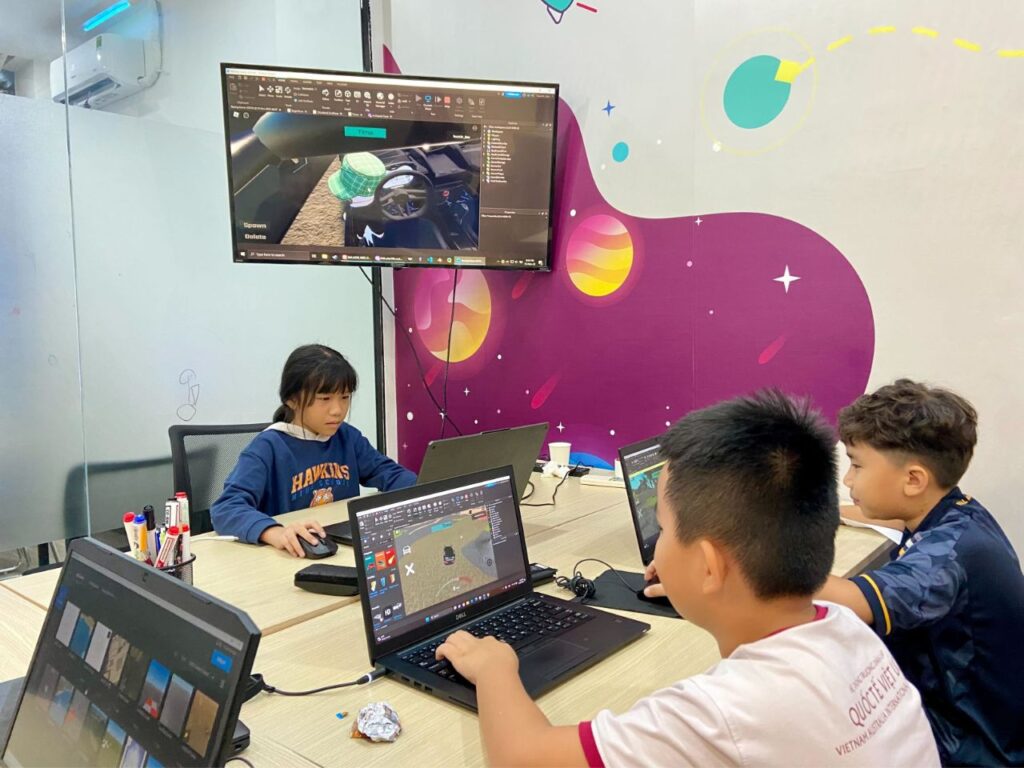
Over 10 weeks students will try to build the best Obby game possible (Judged on completeness of project, use of features, playability and creativity). Through this, they understand the process of developing 3D games and adding features using the Roblox Studio. They learn to use platform tools and create moving parts. Once the game is published, it can be shared with friends and family. On the final day, students will play each others’ games and the best game creators will be awarded cool prizes.
Lesson 1: Introduction to Roblox Studio and user interface
Lesson 2: Alter material properties
Lesson 3: Create a basic platform game
Lesson 4: Game mechanics to create rotating platforms
Lesson 5: Using coding scripts for dynamic objects
Lesson 6: Dynamite objects and skills integration
Lesson 7: Negate and union - using empty space
Lesson 8: Terrain and landscape development
Lesson 9: Falling objects, teleporting and game completion
Lesson 10: Graduation and Competition results
Coding knowledge is an essential skill for many professions across various industries. It is not limited to the field of information technology; several other sectors also demand coding skill. Especially in the era of Technology 5.0, where technology is becoming increasingly prevalent and advancing, the demand for workforce with coding knowledge is on the rise. Let's explore the industries that currently require coding knowledge with Algorithmics.
The IT sector is the one that requires coding knowledge the most. Various job positions in IT, such as programmers, software engineers, data engineers, and security engineers, all necessitate a strong programming foundation.

Industries Requiring Coding Knowledge
Programmers: Responsible for writing code to create software, applications, and websites.
Software Engineers: Design, develop, and maintain software applications.
Data Engineers: Responsible for collecting, processing, and analyzing data.
Security Engineers: Responsible for protecting information systems from security threats.
AI/Machine Learning Engineer: Develops AI/Machine Learning systems.
Network Engineer: Designs, deploys, and maintains network systems.
Security Engineer: Protects information systems from security threats.
Database Administrator: Manages and maintains databases.
Database Architect: Designs and deploys database systems.
Graphic Designer: Designs user interfaces and visual content.
Web Designer: Designs and develops websites.
App Designer: Designs and develops applications.
Project Management: Manages IT projects.

Industries Requiring Coding Knowledge
Other Positions:
In addition to the mentioned roles, there are other positions such as Cloud Computing Engineer, DevOps Engineer, Big Data Engineer, and AI/Machine Learning Engineer.
Financial companies are increasingly incorporating technology into their operations. Therefore, positions in the financial industry, such as data analysts and financial application developers, also require coding knowledge.
Data analysts in the financial industry are responsible for collecting, processing, and analyzing financial data. Financial application developers are tasked with developing financial applications, such as payment systems and financial management systems.

Industries Requiring Coding Knowledge
Below are some positions in the financial industry that require programming knowledge:
Financial Engineer: These individuals design, develop, and maintain financial systems. Programming knowledge is essential for building systems such as transaction systems, asset management, and electronic banking.
Financial Data Analyst: They use data to make financial decisions and need programming knowledge to gather, process, and analyze financial data effectively.

Industries Requiring Coding Knowledge
Financial Data Scientist: These professionals use data science techniques to solve financial problems. With programming knowledge, they develop data science models and algorithms for financial analysis.
Financial Project Manager: Financial project managers are responsible for overseeing financial projects. They need programming knowledge to manage financial systems and applications used in projects.
In addition, other positions in the financial industry, such as financial advisors, investment specialists, and traders, also benefit from programming knowledge. Programming skills enable them to automate processes, analyze data more efficiently, and develop new skills in the rapidly evolving financial landscape.
Nowadays, many factories and industries utilize computer-controlled automation systems. Therefore, positions in the manufacturing industry, such as automation engineers and control engineers, also require programming knowledge.
Automation engineers in the manufacturing industry are responsible for designing, installing, and operating automated systems. Control engineers in the manufacturing sector are responsible for programming automatic control systems.

Industries Requiring Coding Knowledge
Automation Engineers: Design, install, and operate automated systems.
Control Engineers: Program control systems for automation.
Manufacturing Engineer: Designs, operates, and optimizes manufacturing processes, using programming skills for automated control systems, production monitoring systems, and production management systems.
Product Design Engineer: Designs and develops new products, utilizing programming skills for 3D modeling and dynamic simulations.
Maintenance Engineer: Responsible for maintaining and repairing equipment and machinery in the factory, applying programming skills for automated control systems and monitoring systems.

Industries Requiring Coding Knowledge
Other Positions in Manufacturing:
Other roles like Quality Control Engineers, Process Engineers, and Data Engineers may also require programming skills depending on the specific needs of each business and project.
Educational technology is experiencing robust development with the emergence of online learning platforms, learning applications, and more. Positions in the education sector, such as IT teachers and educational content developers, also require programming knowledge.
IT teachers in the education sector are responsible for instructing students in information technology subjects. Content developers in education are tasked with creating online educational content, including lectures and exercises.

Industries Requiring Coding Knowledge
Specific positions in the education sector that demand programming knowledge include IT Teachers, Teachers in Natural Sciences, CIOs, and Digital Content Developers.
IT Teachers: Require in-depth programming knowledge to teach programming languages, programming techniques, operating systems, and computer networks.
Teachers in Natural Sciences: To effectively use information technology in teaching science subjects, teachers need basic programming knowledge.
Chief Information Officers (CIOs): Manage the IT systems of educational institutions and need in-depth programming knowledge for effective leadership.
Digital Content Developers: Develop digital content such as lectures, videos, and games for teaching purposes, requiring programming knowledge for interactive and dynamic content.

Industries Requiring Coding Knowledge
Other Positions in Education:
Positions like Academic Advisors, Instructional Designers, and E-learning Specialists may benefit from programming knowledge for curriculum development and educational technology integration.
In recent years, the healthcare industry has been gradually transitioning to the application of Information Technology (IT) in the areas of examination, treatment, management, and training. This shift has created a demand for programming skills in the healthcare sector.

Industries Requiring Coding Knowledge
Hospital management systems, healthcare applications, and other related technologies are becoming increasingly prevalent. Consequently, positions in the healthcare industry, such as biomedical engineers and healthcare application developers, also require programming knowledge.
Biomedical engineers in the healthcare industry are responsible for developing medical devices and healthcare applications. Healthcare application developers, on the other hand, are tasked with creating applications for healthcare, such as hospital management systems and appointment scheduling apps.
Specific positions in the healthcare sector that demand programming knowledge include Healthcare Engineers, Data Scientists in Healthcare, Healthcare Application Developers, and Healthcare IT Instructors.
Healthcare Engineers: Responsible for designing, developing, and maintaining IT systems in the healthcare field.

Industries Requiring Coding Knowledge
Data Scientists in Healthcare: Utilize programming skills for efficient data collection, processing, and analysis to support medical research, develop new treatment methods, and enhance healthcare quality.
Healthcare Application Developers: Develop applications for healthcare purposes, such as hospital management systems, telemedicine applications, and patient record systems.
Healthcare IT Instructors: Teach IT subjects to healthcare professionals, requiring programming knowledge for effective instruction.
Other Positions in Healthcare:
Roles like Medical Researchers, Healthcare Data Analysts, and Healthcare IT Managers may also benefit from programming skills depending on specific project requirements.
Businesses are increasingly utilizing various online marketing tools such as websites, mobile applications, etc. Therefore, positions in the marketing industry, such as website designers and mobile application developers, also require programming knowledge.
Website designers in the marketing industry are responsible for designing and developing websites for businesses. Mobile application developers are tasked with developing mobile applications for businesses.

Industries Requiring Coding Knowledge
Website Designers: Responsible for designing and developing websites for businesses.
Mobile App Developers: Develop mobile applications for businesses.
Digital Marketing Managers: Manage digital marketing activities and may require programming knowledge for effective strategy implementation.
Data-Driven Marketing Managers: Analyze data for marketing decisions and may require programming skills for efficient data collection and analysis.
Martech Managers: Manage digital marketing tools and platforms, utilizing programming skills for effective deployment.
Other Positions in Marketing:
Roles like Marketing Analysts, SEO Specialists, and Content Creators may also benefit from programming knowledge for data analysis, website optimization, and content automation.

Coding knowledge is a crucial and necessary skill across various industries. In the era of Technology 5.0, where technology is becoming increasingly pervasive and evolving, the demand for a workforce with programming skills is growing rapidly.
Discover a unique coding course designed for children aged 8-12 at Algorithmics! Learning to code is not only an innovation but also an opportunity to develop reasoning and creativity. The Visual Programming course provides an engaging storyline and 6 fundamental modules, helping children develop logical and creative skills. Join us in supporting your child's comprehensive development!
Mobile games are becoming increasingly popular among children. According to the World Health Organization (WHO) statistics, 70-80% of children aged 10-15 enjoy playing games on their phones.

Coding course for children aged 8-12 at Algorithmics Vietnam
While playing mobile games can bring many benefits to children, such as:
Intellectual Development: Mobile games require children to solve problems, use logical reasoning, and create strategies. This helps develop intelligence, problem-solving skills, and critical thinking.
Skill Enhancement: Mobile games can help children enhance skills such as reflexes, hand-eye coordination, and focus. This contributes to the development of essential skills for life and learning.
Boosting Creativity: Mobile games often have a high level of creativity, demanding children to think, imagine, and generate new ideas. This helps foster creativity and independent thinking.

Coding course for children aged 8-12 at Algorithmics Vietnam
However, alongside the benefits, playing mobile games also poses various risks for children, especially the risk of game addiction. Based on the statistics mentioned, 10-15% of children may be addicted to games. Game addiction can lead to neglect of studies, distancing from friends and family, and impact physical and mental health.
So, what can parents do to help their children play mobile games in a healthy way?
Playing games is a common form of entertainment that offers many benefits to children if done correctly. However, it also carries risks, especially the risk of game addiction. To help develop critical thinking while playing games without falling into addiction, parents should consider the following:
Choose Appropriate Games: Select games that contribute to healthy cognitive development, avoiding negative influences. Suitable games should have wholesome content, be non-violent, non-stimulating, and require players to apply their brains to solve problems.
Set Time and Rules for Gaming: Establish reasonable time limits and rules for playing games to prevent dependence. Players should only engage in gaming for a specified amount of time each day, avoiding excessive play.

Coding course for children aged 8-12 at Algorithmics Vietnam
Increase Other Activities: Besides gaming, encourage participation in other activities for comprehensive development and to avoid dependence on games. Other activities may include studying, sports, extracurriculars, etc.
Enroll in Coding Courses: In addition to choosing suitable games, parents can encourage children to participate in coding courses. Game programming is a valuable skill in the digital age, helping children develop logical thinking, problem-solving skills, creativity, and teamwork.

Coding course for children aged 8-12 at Algorithmics Vietnam
Children aged 8-12 are at a golden age for developing logical thinking and creativity. Programming is an excellent subject for nurturing these skills. The Visual Programming course for children aged 8-12 is designed with an exciting storyline about the journey of Marsobot, a robot with a dream of building a base on Mars. Students will accompany Marsobot to complete this base, exploring and applying basic programming concepts in the process.
The storyline revolves around Marsobot's journey to Mars. Marsobot needs to build a base on Mars for living and working, and students are enlisted to help. Students will be assigned various tasks to assist Marsobot in constructing the base. For example, they might be tasked with creating a construction machine to build buildings or designing a transportation system to move construction materials.
The captivating storyline helps children learn programming naturally and with enthusiasm. Kids will immerse themselves in the world of Marsobot, feeling like they are part of an exploration and construction journey on Mars.

Coding course for children aged 8-12 at Algorithmics Vietnam
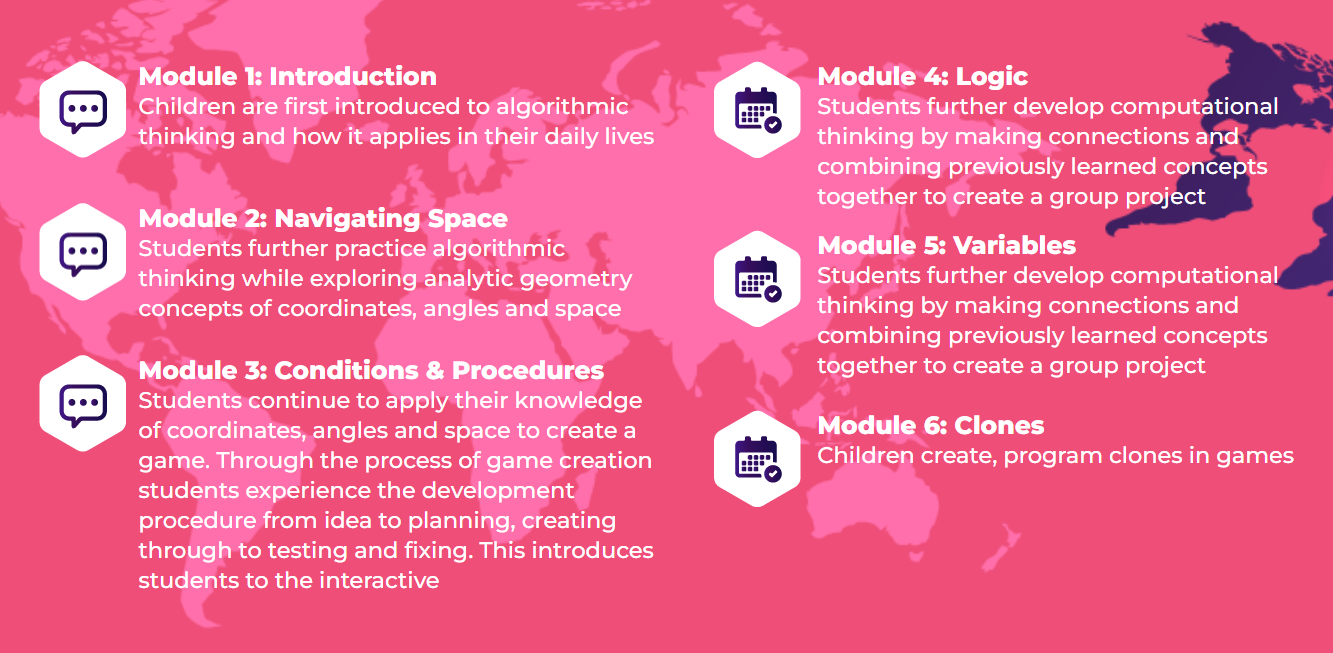
The Visual Programming course comprises 6 modules, each introducing a fundamental programming concept. These concepts include:
Algorithmic Thinking: Students learn basic algorithmic thinking concepts, such as analysis, synthesis, and problem-solving.
Spatial Navigation: Students learn how to use mathematical concepts to locate and move objects in space.
Conditions and Procedures: Students learn how to use conditions and procedures to control program flow.
Logical Reasoning: Students learn how to use logical concepts for inference and decision-making.
Variables: Students learn how to use variables to store data in programs.
Replication: Students learn how to create copies of objects in the program.
Coding course for children aged 8-12 at Algorithmics Vietnam
These basic programming concepts form a crucial foundation for advanced programming learning. Upon completing the course, students will have a solid programming foundation and can continue with advanced programming courses.
Programming requires logical thinking and creativity. The Visual Programming course helps children develop both of these skills.
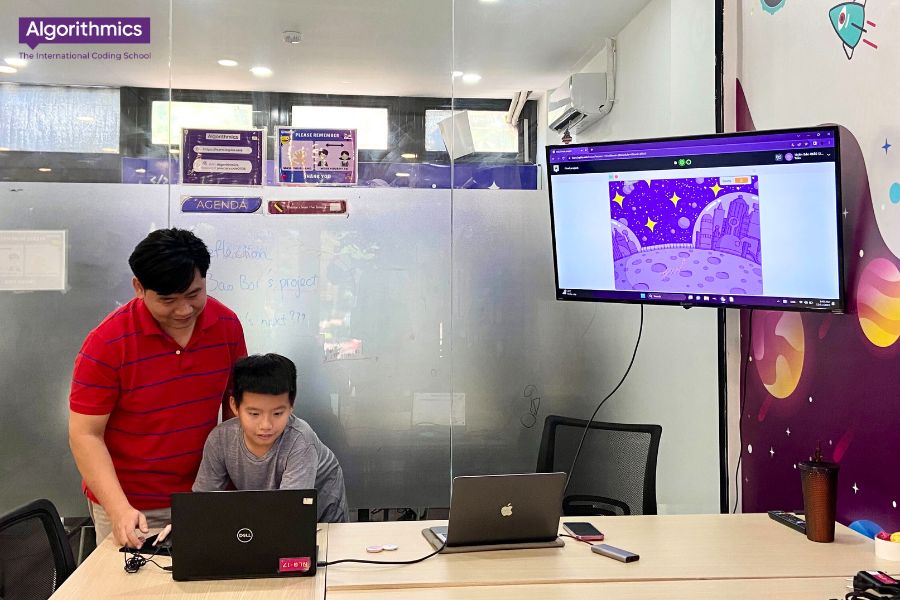
In terms of logical thinking, the course teaches children how to analyze, synthesize, and solve problems. These are essential life skills that contribute to success in academics and work.
Regarding creativity, the course helps children develop imaginative and independent thinking. These skills are necessary for generating new ideas and solving problems creatively.
The Visual Programming course is an excellent choice for children aged 8-12. The course helps children develop logical thinking, creativity, and other essential skills.
Coding course for children aged 8-12 at Algorithmics Vietnam
In today's rapidly advancing technological era, coding is a crucial skill that contributes to a child's comprehensive development. Moreover, it presents a promising career opportunity for the future. So, why should children aged 7-9 join a coding course for chidlren at Algorithmics?
Coding involves using logical rules to create computer programs. This process helps children hone their logical thinking, analyze situations, and efficiently solve problems.
Coding is not just about writing code; it's also a process of creating innovative products. Through coding courses, children have the chance to express their creativity by developing games, applications, websites, and more.

Coding course for children aged 7-9 at Algorithmics
Coding is a vast and ever-evolving field. To effectively learn coding, children need to possess self-learning abilities, search for information, and tackle challenges independently.
In the digital age, coding is a highly sought-after skill by many employers. Learning coding at an early age provides children with a competitive edge in the future, making it easier for them to secure high-paying jobs.
So, how can you ensure effective coding learning for your child? Parents should choose a program that suits the child's age and abilities. Additionally, creating a conducive learning environment and encouraging self-directed learning are essential.
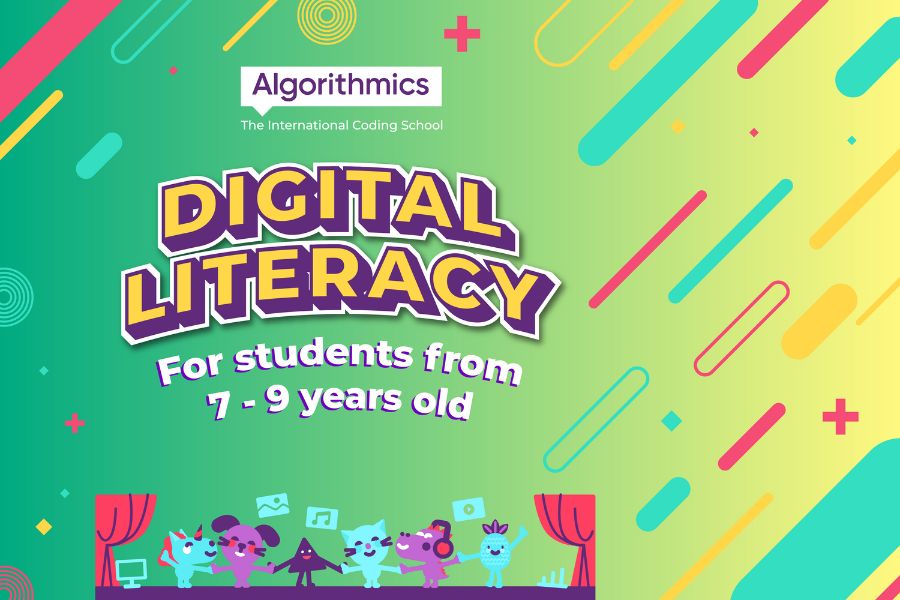
Welcome to Digital Literacy, a unique coding course designed for children aged 7-9 at Algorithmics! This course not only imparts essential coding skills but also embarks on a creative and exciting journey with new friends: Katie, Doc, Unique, Dina, and Pineapple.
At Digital Literacy, your child will not only be a student but also a companion in the learning journey. Their coding experience will be intertwined with activities such as scripting, role-playing, and even organizing a small presentation. This approach helps children develop communication skills and confidence in teamwork.
Digital Literacy goes beyond teaching coding; it's an adventure with an engaging storyline. Learning coding becomes more enjoyable with lessons designed to resonate with children.
Coding course for children aged 7-9 at Algorithmics
The course spans 32 sessions, equivalent to 8 months, allowing gradual development for each child. With 90 minutes per session and only 12 students per class, your child will receive close support and monitoring throughout the learning process.
Digital Literacy offers 8 main modules, ranging from basic to advanced topics:
Basics: Understanding information and how computers process and store data.
Graphic Editing Software: Creativity with digital art and personal projects.
Online Communication: Information security and online communication rules.
Online Information Retrieval: Verifying information online.
Presentation Building: Introduction to presentations and creating graphic slides.
Spreadsheet Editing: Using spreadsheets to solve mathematical problems.
Visual Information Presentation: Using tools like Canva to visualize data.
Budget Management and Expenses: Learning how to create invoices and personal budget planning.
Coding course for children aged 7-9 at Algorithmics
In the Digital Literacy course, children will achieve a variety of important learning outcomes. Firstly, they will grasp fundamental knowledge and skills in computer operations, boosting their confidence in daily technology use. Algorithmics focuses on helping children understand how computers operate, process information, and utilize cloud storage, providing a foundation for flexibility and efficiency in work and studies.

Coding course for children aged 7-9 at Algorithmics
Furthermore, children will learn to organize and manage data effectively, enhancing organizational skills and intelligent information access. The course also emphasizes online communication and the protection of personal information in online communities, developing crucial skills for maintaining a safe and positive online environment.
Children will also gain solid knowledge of information storage on the internet, search skills, and information verification, transforming them into smart information consumers. Finally, the course provides opportunities to develop design, construction, and presentation skills effectively using tools like Pixel and Canva, enabling children to become multimedia-savvy and adaptable individuals in today's digital world.
Let your child experience an exciting and creative learning journey with Digital Literacy. Register now to assess your child's analytical skills and ensure a future filled with knowledge and skills!
Coding course for children aged 7-9 at Algorithmics
Discover how Artificial Intelligence (A.I.) is transforming the landscape of teaching and learning, offering personalized educational content, diverse teaching methods, and innovative applications. Algorithmics presents five applications of Artificial Intelligence in educating children.
One of the most visible applications of Artificial Intelligence in teaching children is the personalization of learning content. A.I. tailors educational content based on students' needs, abilities, and interests, enhancing their knowledge absorption. Research from Harvard University indicates that personalized learning yields better academic results compared to traditional methods, fostering high motivation and adaptability in students.

5 applications of artificial intelligence
A.I. can personalize learning for children through:
Analyzing learning data: A.I. analyzes students' learning data to identify strengths, weaknesses, interests, and abilities, suggesting suitable learning paths.
Generating tailored learning content: A.I. can create customized learning materials, such as exercises and lectures, aligned with each student's proficiency, addressing specific challenges.
Artificial Intelligence not only improves teaching and learning processes but also introduces new, engaging teaching methods. With A.I. support, teachers can personalize learning journeys for individual students, making knowledge absorption more effective. A.I. can create dynamic, interactive lessons, capturing students' interest.

5 applications of artificial intelligence
Specific methods of diversifying teaching through A.I. include:
Creating dynamic, interactive lessons: A.I. utilizes technologies like virtual and augmented reality to develop lively, interactive lessons, facilitating students' understanding of abstract concepts.
Answering students' queries: A.I. chatbots can provide 24/7 answers to students' questions, promoting continuous learning without waiting for scheduled class times.
Applying A.I. to diversify teaching methods benefits both teachers and students by saving time, effort, and enhancing teaching efficiency.
The integration of Artificial Intelligence in self-learning and remote education is becoming increasingly prevalent. With A.I. support, self-learning and remote education become more accessible and efficient. Students can access diverse, personalized learning resources and interact with lessons anytime, anywhere.

5 applications of artificial intelligence
Common A.I. applications in self-learning and remote education include:
Efficient self-learning: A.I. utilizes data understanding and analysis capabilities to create personalized, adaptable learning content, simplifying the learning process.
Remote learning support: A.I. ensures a smooth online learning experience while optimizing remote learning through various approaches.
Flexible interaction: A.I. acts not just as a learning tool but also as an intelligent interactive partner, aiding in critical thinking, questioning, and providing natural feedback.
Various A.I.-powered learning applications, such as Elsa Speak and Duolingo, contribute to effective self-learning and remote education.
The trend of integrating Artificial Intelligence into academic assessment is inevitable in the digital age. A.I. enhances the objectivity, accuracy, and personalization of academic assessments, contributing to overall education quality.

5 applications of artificial intelligence
A.I.-based academic assessment methods include:
Automatic grading for multiple-choice and fill-in-the-blank assignments.
Monitoring learning progress through activities like assignment submissions and participation in discussions.
A.I.'s advantages in assessment include objectivity, quick results processing, and personalized evaluation, helping teachers understand each student's strengths and weaknesses for tailored teaching methods.
A.I. can predict career directions more logically, assisting learners in finding occupations that align with their interests, capabilities, and needs. Career guidance through A.I. involves data analysis and direct consultation through chatbots, empowering individuals to make informed career choices.

5 applications of artificial intelligence
A.I.-driven career guidance methods include:
Data analysis: A.I. evaluates learners' interests, capabilities, and needs to suggest suitable career paths.
Direct consultation: Chatbots offer direct advice through conversations, enhancing self-awareness and understanding of suitable professions.
Self-guidance: A.I. tools provide necessary information for individuals to independently determine career paths.
The application of A.I. in career guidance is a significant trend in the digital era, offering quick, accurate, and personalized career advice to enhance life quality.
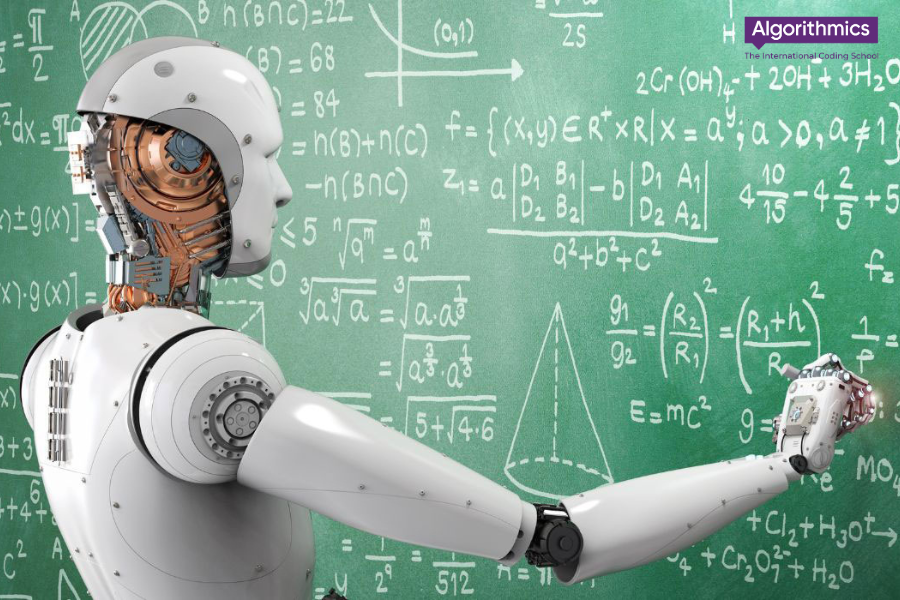
Applying A.I. to optimize time efficiently is an inevitable trend in the digital age. A.I. aids in time and effort savings, improving work efficiency and job satisfaction.
5 applications of artificial intelligence
Benefits of applying A.I. to optimize time include:
Time and effort savings: A.I. helps save time and effort, allowing individuals to focus on crucial tasks.
Enhanced work efficiency: A.I. boosts human efficiency, facilitating quicker goal achievement.
Increased job satisfaction: A.I. aids in reducing stress and pressure at work, contributing to higher job satisfaction.
Artificial Intelligence has brought significant innovations to education, from personalized learning and diverse teaching methods to self-learning support, academic assessment, career guidance, and efficient time optimization. The creative synergy between technology and humanity is shaping a promising and positive future for education.
5 applications of artificial intelligence
In the age of technology 5.0, coding is becoming one of the most important skills that children need to be equipped with. Learning to code from an early age will help children develop logical thinking, problem-solving, creativity, and adaptability to the changing world. Here are the top 5 coding schools for children in HCMC:
Algorithmics is the first international standard coding school in Vietnam. Founded by leading experts in the technology field from Russia, the school provides coding courses for children from 5.5 to 17 years old. Currently, Algorithmics coding school has been present in over 90 countries with over 1.1 million students.
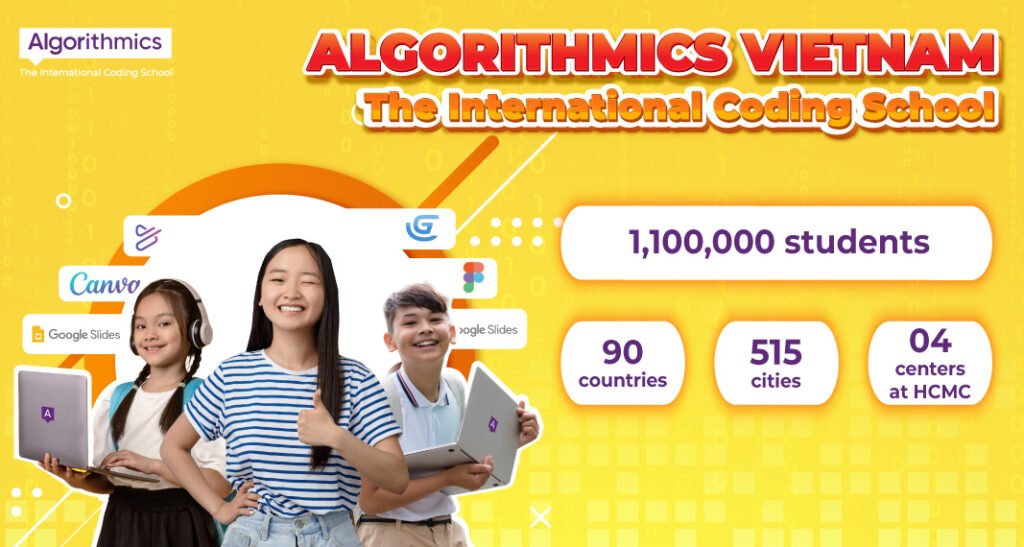
Algorithmics is highly rated for its specialized teaching and learning methods, which help children develop holistically. This method is built on thorough research on the psychology and ability to absorb children.
Comprehensive training program: built on the international education framework, including basic knowledge about programming, computer science, to in-depth knowledge such as web design, mobile applications, etc. to diversify choices for students.
Teaching methods are always updated: Algorithmics applies 3 main teaching methods: Blended Learning (blended learning); Project-based Learning (learning through projects) and Cooperative Learning (interactive learning). From there, children will develop logical thinking, problem-solving and creativity. This method encourages children to learn independently, explore and solve problems through real-world projects.
Designed specifically for children with the application of "gamification" to increase interest, turning learning into an exciting game. Stimulating the passion for learning, the curiosity of children. With this platform, children will learn coding in a fun and effective way.
Top 5 Coding Schools for Children in HCMC
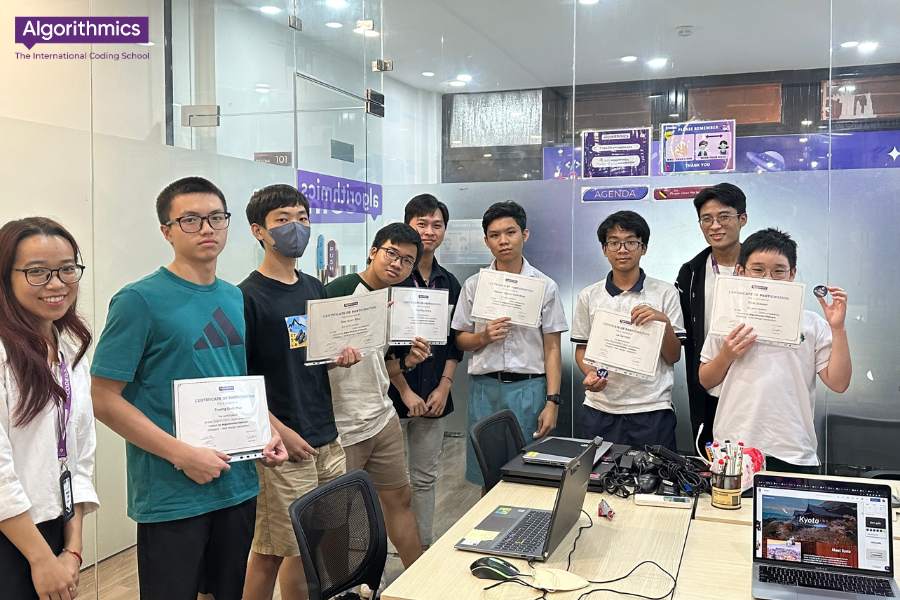
Algorithmics' exclusive platform: erienced teachers: Algorithmics has a team of experienced and dedicated teachers, always attentively guiding students. Algorithmics' teachers all have high professional qualifications and have experience teaching children. Not only that, Algorithmics also has foreign teachers, helping children not only learn coding but also practice English in the classroom.
Extracurricular activities: every month Algorithmics creates playgrounds for students to explore many life knowledge, technology topics to help children relax but also not less beneficial.

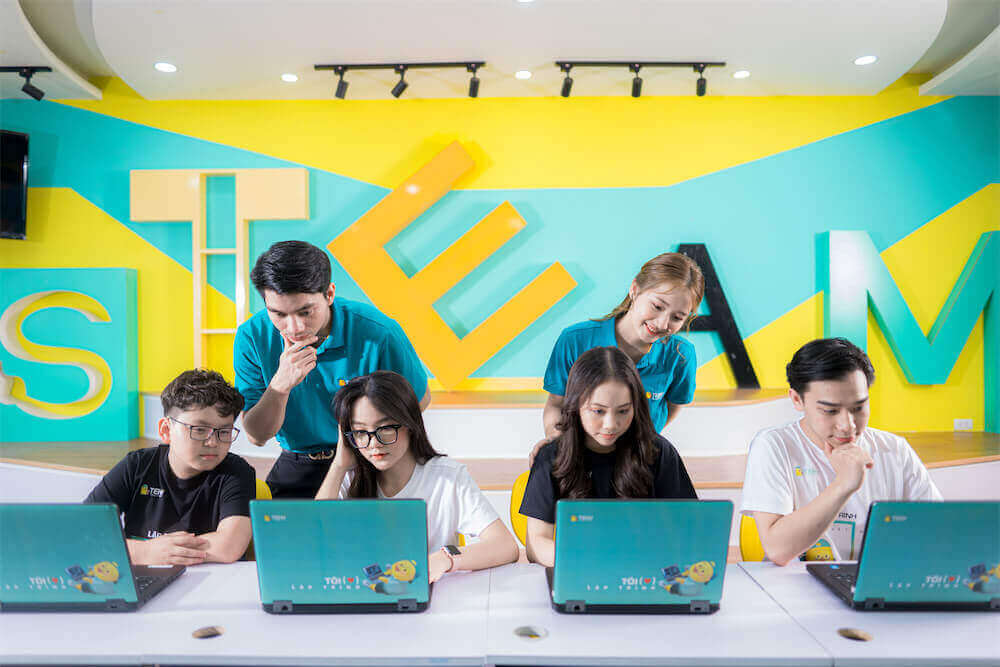
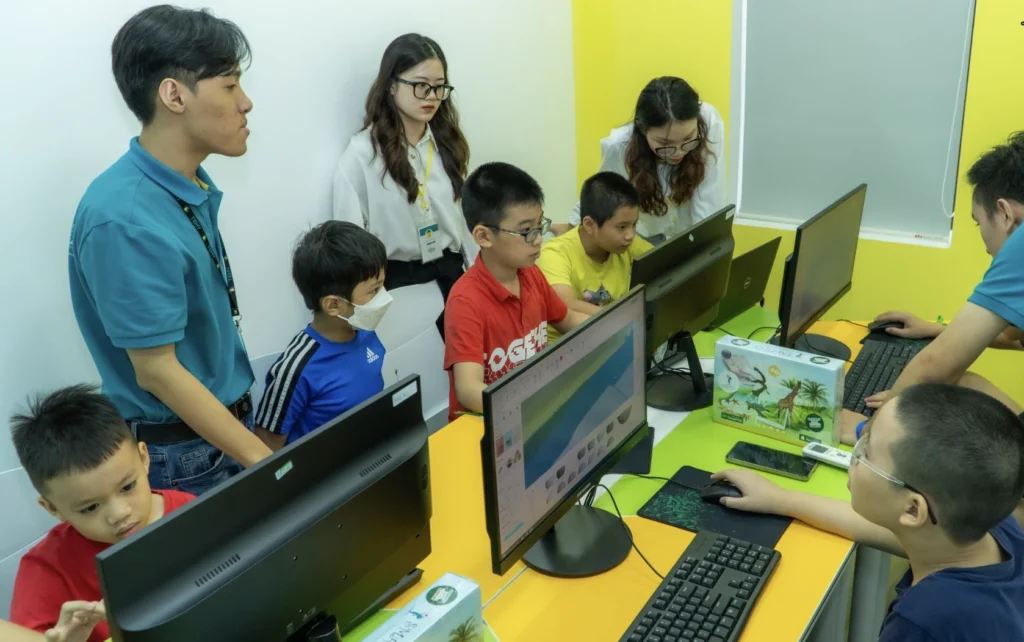
Teky is a creative technology academy with a STEAM (Science – Technology – Engineering – Art – Mathematics) curriculum. Founded in June 2016, Teky is a coding school with a mission to bring Vietnamese children comprehensive knowledge about STEAM, especially technology thinking, creativity, and problem-solving.
Top 5 Coding Schools for Children in HCMC
Training program includes the following fields: Programming with popular programming languages such as Scratch, Python, Java, ..., engineering, art, mathematics, computer science
Learning method: Teky applies the active learning method, encouraging students to explore and solve problems. This method helps students develop logical thinking, problem-solving, and creativity.
Top 5 Coding Schools for Children in HCMC
Infrastructure: Teky has modern infrastructure to meet the needs of students. The classrooms are equipped with all the necessary equipment for learning, such as computers, projectors, etc.
Teaching staff: Teky has a team of experienced and dedicated teachers, always attentively guiding students. Teky's teachers all have high professional qualifications and have experience teaching children.
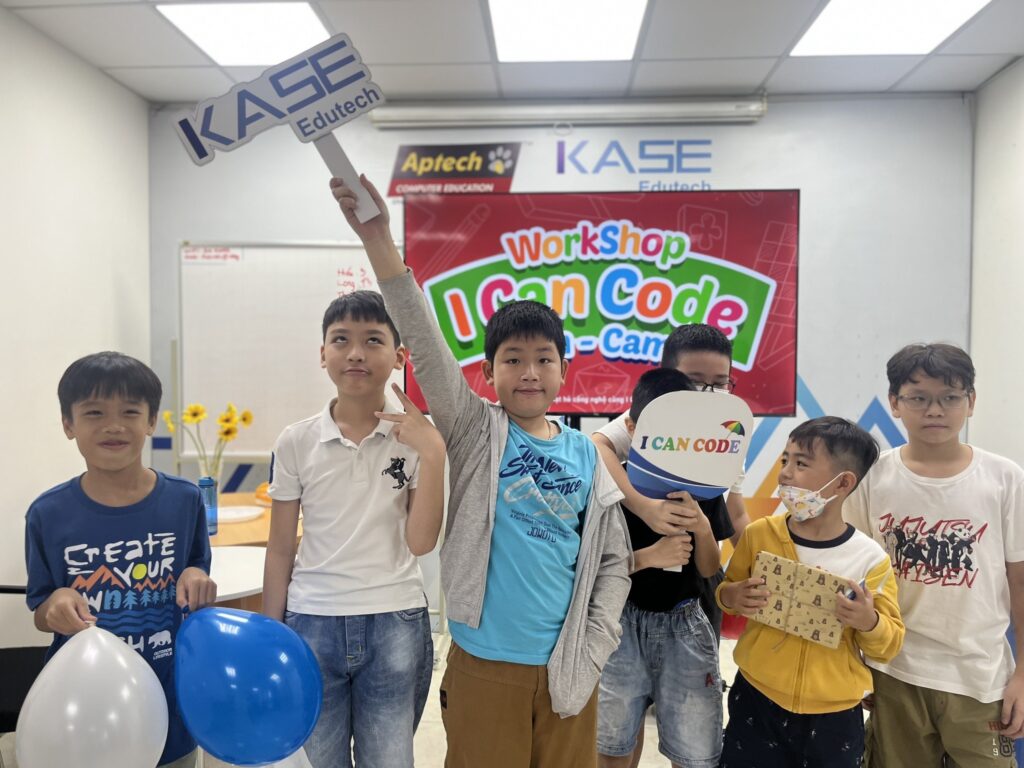
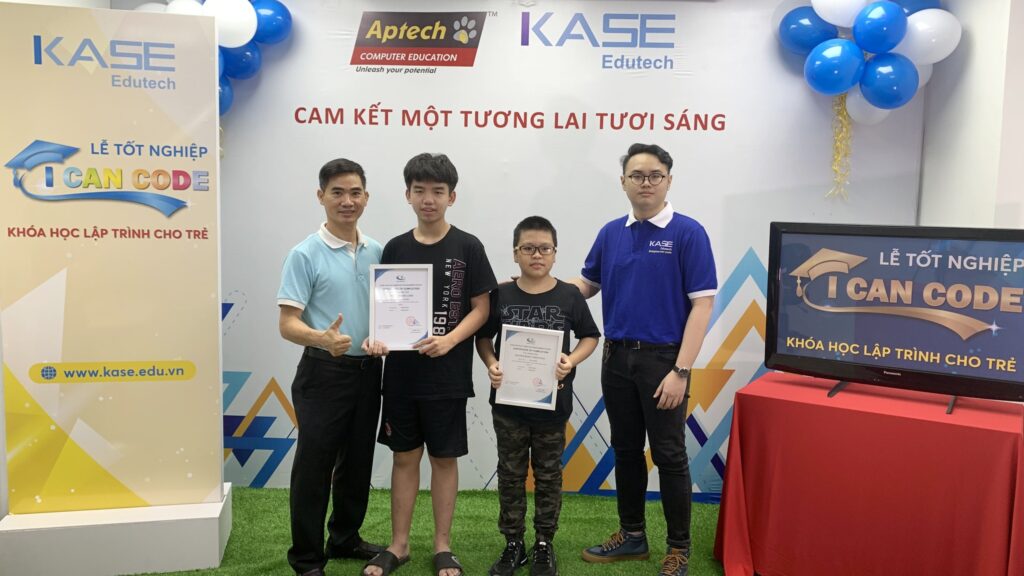
KASE Coding School is a technology academy specializing in training courses on programming, robots, graphics, and AI for children from 4 to 18 years old. The school was founded in 2017 with the goal of providing Vietnamese youth with a solid foundation in technology and helping them develop creative thinking and problem-solving skills.
Top 5 Coding Schools for Children in HCMC
International, up-to-date curriculum: KASE Coding School uses an international curriculum that is updated regularly to help students access the latest knowledge in the field of technology. The curriculum is designed to develop creative thinking and problem-solving skills, helping students develop comprehensively in terms of knowledge and skills.
Top 5 Coding Schools for Children in HCMC
Experienced faculty: KASE Coding School has a team of experienced and highly qualified instructors who are trained at reputable universities and colleges in Vietnam and abroad. The faculty are always dedicated, enthusiastic, and ready to support students throughout their learning process.
Modern facilities: KASE Coding School has modern facilities that meet the needs of students' learning and practice. The classrooms are equipped with computers, devices, and software to create a convenient learning environment for students.
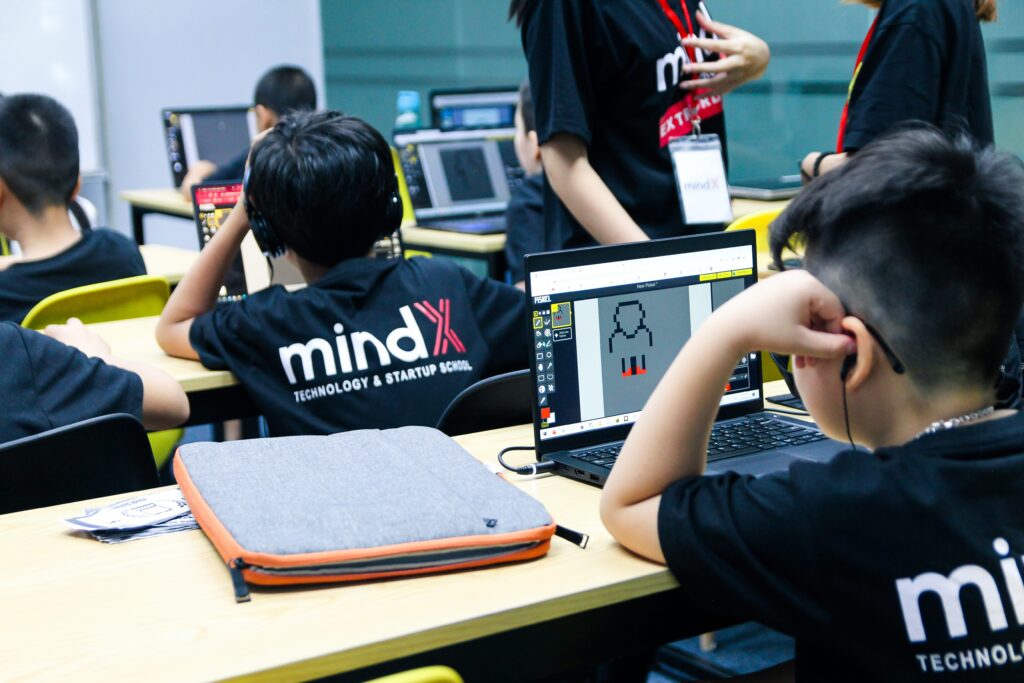
MindX is a modern technology education system for children from 6-18 years old. The international coding school for children in Ho Chi Minh City was founded in 2015 with the goal of bringing to the Vietnamese youth a solid technological foundation, helping them develop creative thinking and problem-solving skills.
Top 5 Coding Schools for Children in HCMC
Uniqueness and innovation: MindX is highly regarded for its application of innovative and advanced teaching methods. The training content is regularly updated to reflect industrial trends and the labor market.
Quality of faculty: MindX focuses on recruiting and developing a team of highly qualified and experienced teachers. Ensuring that students receive quality support and guidance.
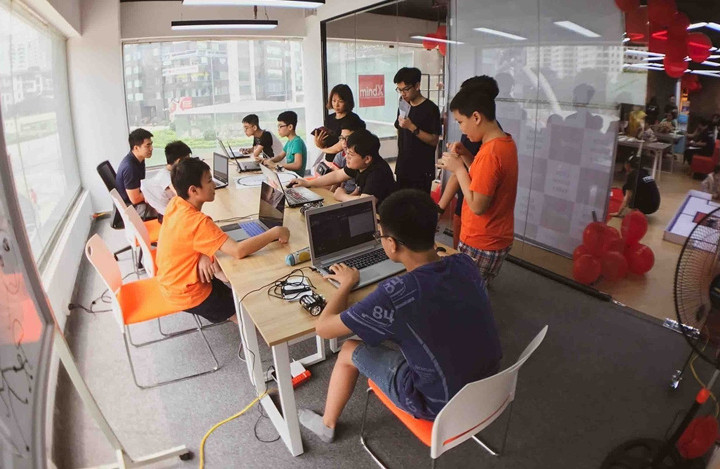
Top 5 Coding Schools for Children in HCMC
Positive learning environment: Regularly organizes events, real-world projects, and extracurricular activities. Events encourage interaction and learning between students. Creating a positive and motivated learning environment.
Flexible training program: MindX provides flexible training programs. Responding quickly to market demand and reflecting the diversity of the industry. This helps students have the opportunity to learn the latest skills and knowledge.
Top 5 Coding Schools for Children in HCMC